


Blog
Borehole Drilling in Kenya: Cost and Requirements

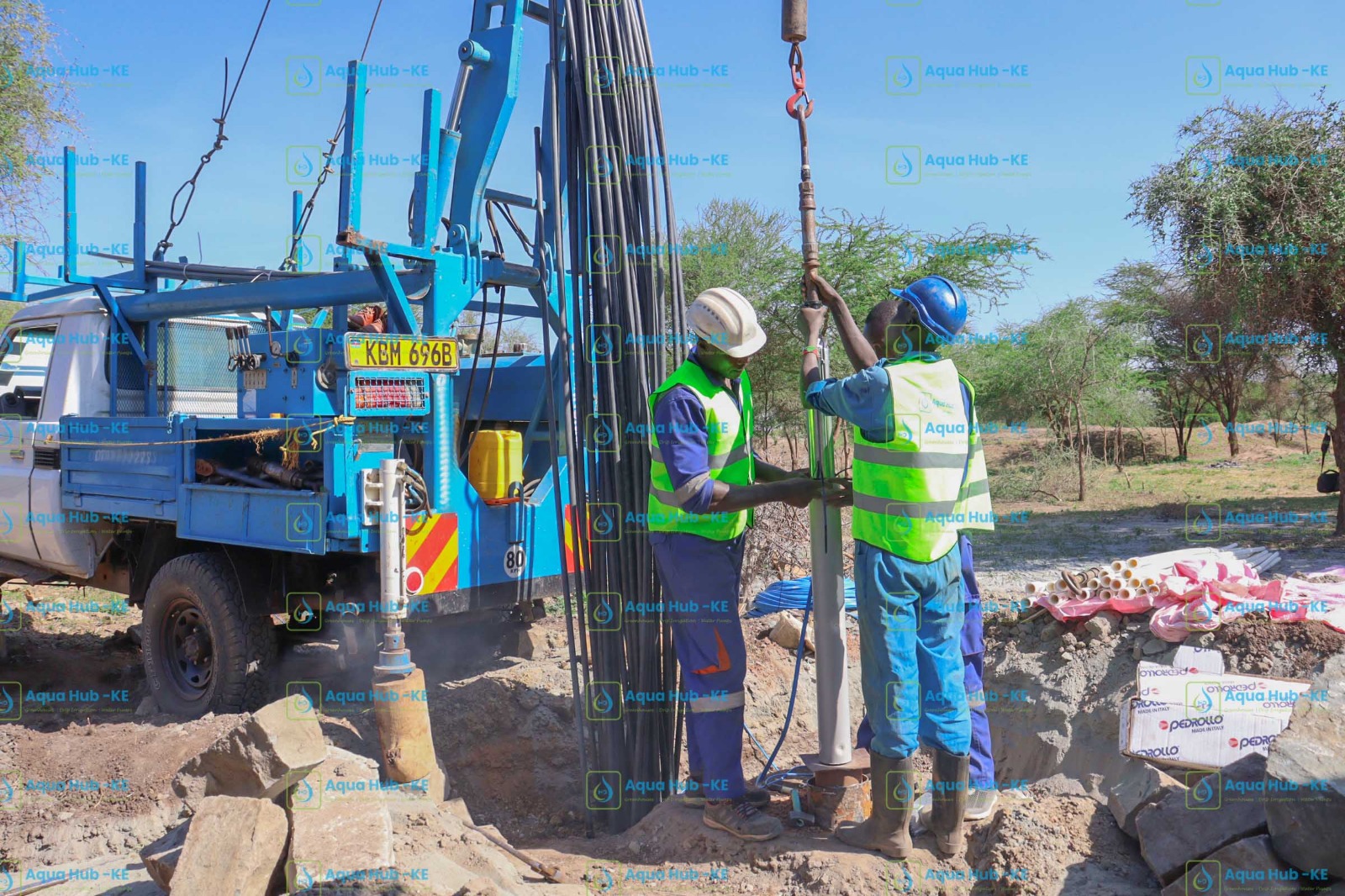
Aqua Hub Kenya is one of the recognised borehole drilling companies in Kenya, with an average cost of KES 5,500 to KES 7,500 per meter. These prices are effective January 2026. Most boreholes will have flow rates of 2000 litres per hour to 50,000 litres per hour.
We guide our clients through consultation, borehole drilling, pump testing, sizing, and installation. Our borehole drilling technology, experience, and top-performance pumps guarantee success and reliable clean water access.
Call 0711138312
In this guide we take you through borehole drilling cost, requirements, and how drilling is done to help you make informed decisions.
What Is Borehole Drilling?
Borehole drilling is the process of excavating a deep, narrow well to access clean water in the underlying rocks below the ground.
Why Borehole Drilling in Kenya?
Many regions in Kenya still face the constraints of insufficient water for domestic, livestock, or agricultural needs. Due to low rainfall in most parts of Kenya, especially dry areas, borehole drilling is vital for constant water access.
A well-drilled borehole can provide reliable water access for many years.
Borehole Drilling Cost in Kenya
The cost of borehole drilling in Kenya varies with depth, geological survey, and permits. The total cost of borehole drilling and equipping with a suitable pump could range from KES 700,000 to KES 2,500,000 or more. The borehole depth, site location, and pump specifications affect the cost.
Here is a breakdown of the cost:
- Borehole Drilling per meter: KES 6,000 – 9,500; hard rock costs more
- Hydrogeological survey: KES 50,000–150,000 to locate water and the best drilling location.
- Permits & licensing (WRA, NEMA): KES 30,000 – 100,000
- Pump & equipment: KES 80,000 – 500,000+, depending on pump type and accessories.
Borehole Drilling Methods
Air Drilling
Air drilling is commonly used in areas with compact soil that cannot collapse easily. Uses compressed air to lift grinded rock particles to the ground.
Wet Drilling
Wet drilling is essential in areas with loose or moist soil that can collapse easily. It is costly but ensures the borehole remains intact during and after drilling.
Borehole Drilling Rates by County
| County | Cost (Min) | Cost (Max) |
| Nairobi | KES 6,100 | KES 9,500 |
| Kajiado | KES 6,500 | KES 9,500 |
| Machakos | KES 6,500 | KES 9,500 |
| Kitui | KES 6,600 | KES 9,500 |
| Makueni | KES 6,500 | KES 9,500 |
| Kiambu | KES 6,500 | KES 9,500 |
| Nakuru | KES 6,500 | KES 9,500 |
| Kisumu | KES 6,500 | KES 9,500 |
| Turkana | KES 8,000 | KES 9,500 |
| Bungoma | KES 6,500 | KES 9,500 |
| Busia | KES 7,700 | KES 9,500 |
| Narok | KES 6,800 | KES 9,500 |
| Mombasa | KES 7,000 | KES 9,500 |
| Kilifi | KES 7,500 | KES 9,500 |
| Kwale | KES 7,600 | KES 9,500 |
| Baringo | KES 6,900 | KES 9,500 |
| Siaya | KES 6,500 | KES 9,500 |
| Homabay | KES 6,500 | KES 9,500 |
| Uasin Gishu | KES 6,500 | KES 9,500 |
| Budalangi | KES 6,500 | KES 11,000 |
Note: These rates typically include drilling, casing, test pumping, and water quality analysis.
Borehole Drilling Requirements in Kenya
For you to drill a borehole in Kenya, you must:
Hydro-geological Survey
A hydrogeological survey should be done to assess the structure of rocks, point of drilling, depth of water below the ground, and approximate water volume.
The yield of a borehole is approximated by the water yield of the boreholes nearby. Transient electromagnetic equipment is used to carry out hydrological surveys.
Transient electromagnetic equipment uses advanced technology with pinpoint accuracy with over a 90% success rate. Traditional resistivity methods of survey are vertical electrical sounding (VES) and horizontal electrical profiling (HEP), with a success rate of 60 percent.
Water Resource Management Authority (WARMA) permit
It is a legal requirement to obtain a permit from the Water Resource Management authority for you to drill a borehole. WARMA will need your land title deed to prove ownership, your national identification card, and your KRA PIN certificate to approve your request for a permit.
Approval from NEMA and County Governments
The National Environmental Management Agency (NEMA) must offer approval for a borehole to be drilled. This is essential to ensure that pollution, gas leakages, and other risks are avoided.
Also ensure you obtain approval from the county government if necessary.
Borehole Drilling in Kenya: Step-by-Step Process
Step 1: Conducting Hydrogeological Survey
Before borehole drilling begins, a site visit to conduct a hydrogeological survey is done. A licensed geologist conducts a hydrogeological survey, which maps underground water potential and suggests the best drilling points. This survey is important to prevent dry drilling and losses.
Hydrogeological surveys cost between KES 50,000 and KES 150,000.
Step 2: Obtaining Permits and Legal Requirements
To drill a borehole in Kenya, you must obtain permits from the relevant authorities, such as the Water Resource Management Authority. You may also need approval by NEMA and county permits.
Step 3: Mobilisation
After obtaining the necessary documents and permits, the drilling mobilizes the drilling equipment to the site. The cost of mobilization would vary depending on the location of the site.
Step 4: Borehole Drilling & Casing
The actual process of digging a well into the ground using a borehole drilling rig. The depth that the borehole is dug depends on the borehole survey report. The common diameter size of boreholes is 6 or 8 inches, but the surface section is 10–14 inches.
Step 5: Borehole Casing Installation
After drilling and confirmation of water availability, steel or UPVC casing is installed to prevent collapse or contamination of the borehole. For boreholes with high water salinity or sand content, UPVC casing is ideal.
Step 6: Gravelling
Use of gravel sand to fill the spaces between the borehole walls and steel casing. Gravel filters
Step 7: Flushing and Capping
Water is pushed under intense pressure within the well and released as a jet from the mouth of the well. Flushing cleans the well by removing particles and allows water flow from the aquifer to the well.
After flushing, the well is sealed using a cap to prevent contamination.
impurities and keeps the casing in position.
Step 8: Test Pumping
After drilling, a temporary pump tests yield and flow, and water is analyzed to ensure safety for drinking or irrigation. Test pumping determines the recharge rate and the suitable electric borehole pump and delivery pipe to use.
Step 9: Water Quality Analysis
Laboratory assessment of borehole water to test the purity. Determines the minerals and salts present in water to assess its safety and the right treatment.
Borehole Pump Installation and Equipping
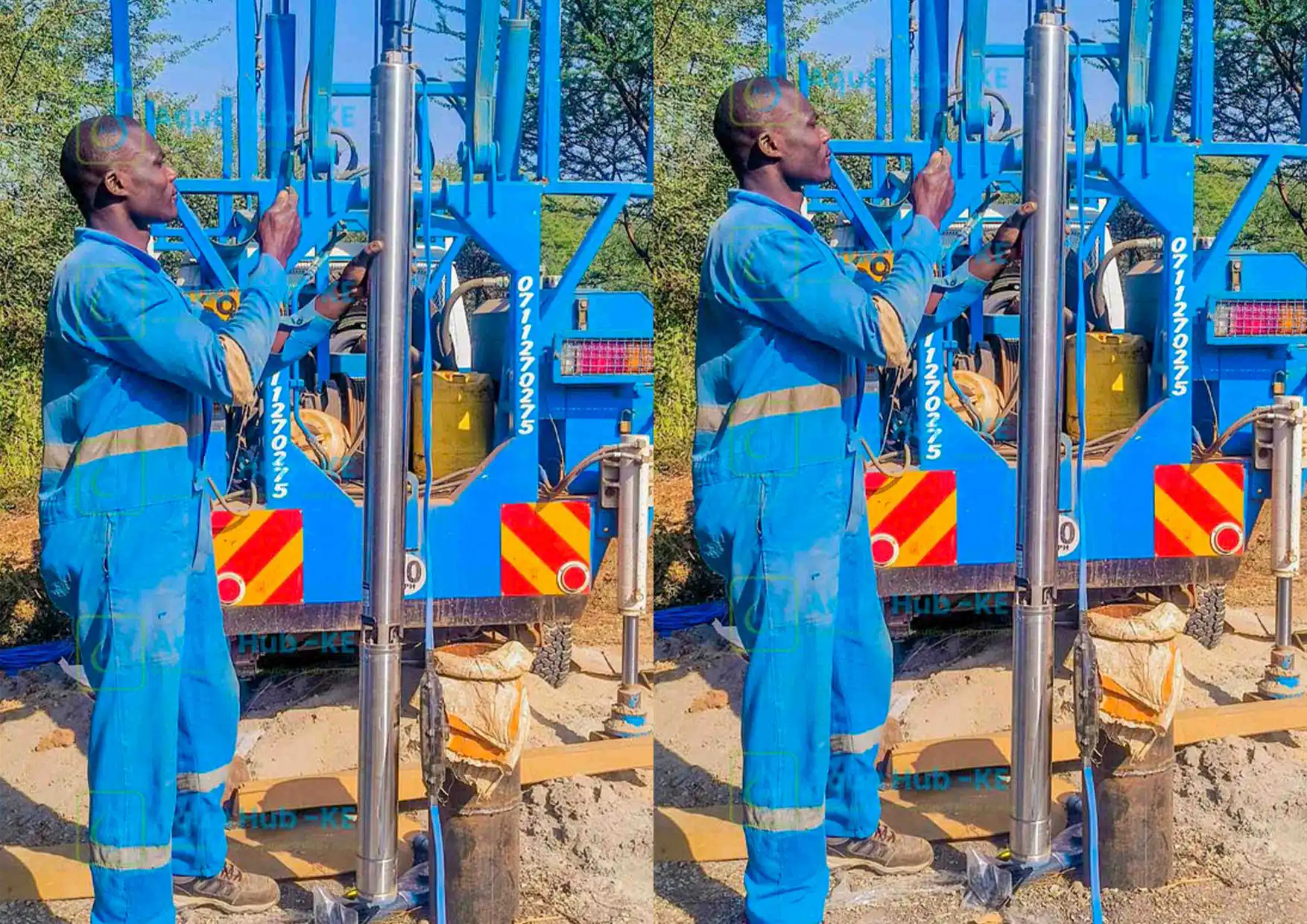
Solar Borehole Pump Installation in Kajiado
Borehole pump installation requires a submersible electric or solar submersible as per the test pumping results. We have submersible pumps that vary in cost as per the depth, flow rate and power ratings.
How Deep Should a Borehole Be in Kenya?
The depth of your borehole depends on the water table and geology of your area. Boreholes in Kenya range from 70 m to 300 m deep. In regions with a high water table, the depth of the borehole will be lower than in those with a low water table.
The hydrological survey is essential to determine optimal borehole depth for yield and sustainable water supply.
Factors That Affect Borehole Drilling Cost
- Soil/Rock Type: Hard rock increases drilling time and cost.
- Depth: areas with deep water table More meters mean higher total cost.
- Location Accessibility: Remote sites raise mobilization fees.
- Drilling method: rotary drilling is faster but more expensive than percussion drilling.
- Casing: Steel casing is expensive, while UPVC casing might cost less.
How to Choose a borehole Drilling Company
When looking for a borehole drilling company, consider:
- registered companies
- Transparent pricing
- Past project references
- Clear contracts and guarantees
Licensed drillers help navigate permits, reduce the risk of dry holes, and ensure compliance.
Benefits of Borehole Drilling in Kenya
- Reliable Water Access: drilling a reliable borehole ensures sustainable water access.
- Saves on Cost: once you have reliable borehole water access, you don’t have to buy municipal water.
- Sustainable Crop Production: You can use borehole water to support crop farming through irrigation.
- Income generation: Borehole water can generate income through water vending or connecting to nearby households.
Frequently Asked Questions
1. What is the cost of drilling a borehole in Nairobi?
KES 6,100–9,500 per metre.
2. How much is drilling a borehole in Kenya?
KES 6,000–9,500 per metre.
3. What permits do I need to drill a borehole in Kenya?
WRA permit, NEMA approval, and county permits.
4. How long does borehole drilling take?
It depends on the depth of the water table and rock structure. May take a week or more.
5. Can I drill without a permit?
WARMA and NEMA permits are compulsory.
6. What influences borehole depth in Kenya?
Depth is based on water table levels and geology
7. Are solar pumps worth the investment?
Yes, solar borehole systems reduce electricity costs and suit remote areas.
8. How do I find underground water before drilling?
Through a hydrogeological survey conducted by professionals.
9. What maintenance costs are there for a borehole?
Maintenance, cleaning, pump servicing, and periodic water testing.
10. Who conducts borehole drilling in Kenya?
Aqua Hub Kenya