


Blog
Borehole Drilling Prices in Kenya


According to the ministry of Water, Sanitation, and Irrigation, annual water access per capita is 452m³ which is far below the annual global expectation of 1000m³. Borehole drilling solves water shortages by enhancing reliable access and extraction of underground water. Borehole drilling in Kenya normally cost around KES 6,000 to KES 10,000 per meter depending on the location. You will also need borehole pumps which cost between KES 200,000 to KES 1,000,000 or more according to the depth of the borehole.
Borehole drilling, test pumping and pump installation services are done by Aqua Hub Kenya. We are ready to make your home water resilient.
Call 0790719020
Quick Takeaways
- Borehole drilling in Kenya costs around KES 6, 500 – KES 10,000 per meter.
- Borehole drilling involves hydrogeological survey, bore drilling, test pumping, water analysis and borehole equipping.
- Borehole Depth often ranges between 60 – 250 meters or more.
- The reliable pump to use is determined by the water needs, power access and depth of borehole.
- Water testing ensures safety and crop suitability
- Borehole drilling and installation is done by Aqua Hub LTD.
Borehole Drilling Prices in Kenya
| Location | Cost (KES) |
| Nairobi | KES 6,100 – 9,500 |
| Kajiado | KES 6,500 – 9,500 |
| Machakos | KES 6,500 – 9,500 |
| Kitui | KES 6,600 – 9,500 |
| Makueni | KES 6,500 – 9,500 |
| Kiambu | KES 6,500 – 9,500 |
| Nakuru | KES 6,500 – 9,500 |
| Kisumu | KES 5,950 – 6,500 |
| Turkana | KES 8,000 – 9,500 |
| Bungoma | KES 5,800 – 6,000 |
| Busia | KES 7,700 – 9,500 |
| Narok | KES 6,800 – 9,500 |
| Mombasa | KES 7,000 – 9,500 |
| Kilifi | KES 7,500 – 9,500 |
| Kwale | KES 7,600 – 9,500 |
| Baringo | KES 6,900 – 9,500 |
| Siaya | KES 5,950 – 6,200 |
| Homabay | KES 6,500 – 9,500 |
| Eldoret | KES 5,800 – 6,100 |
| Budalangi | KES 6,500 – 11,000 |
Borehole Drilling in Kenya
We are the reliable borehole drilling and equipping company in Kenya. Our borehole drilling and pump installation services matches the scope of the client’s water needs.
With reliable borehole water access, you save cost spent on municipal water, grow crops and provide consistent water to animals.
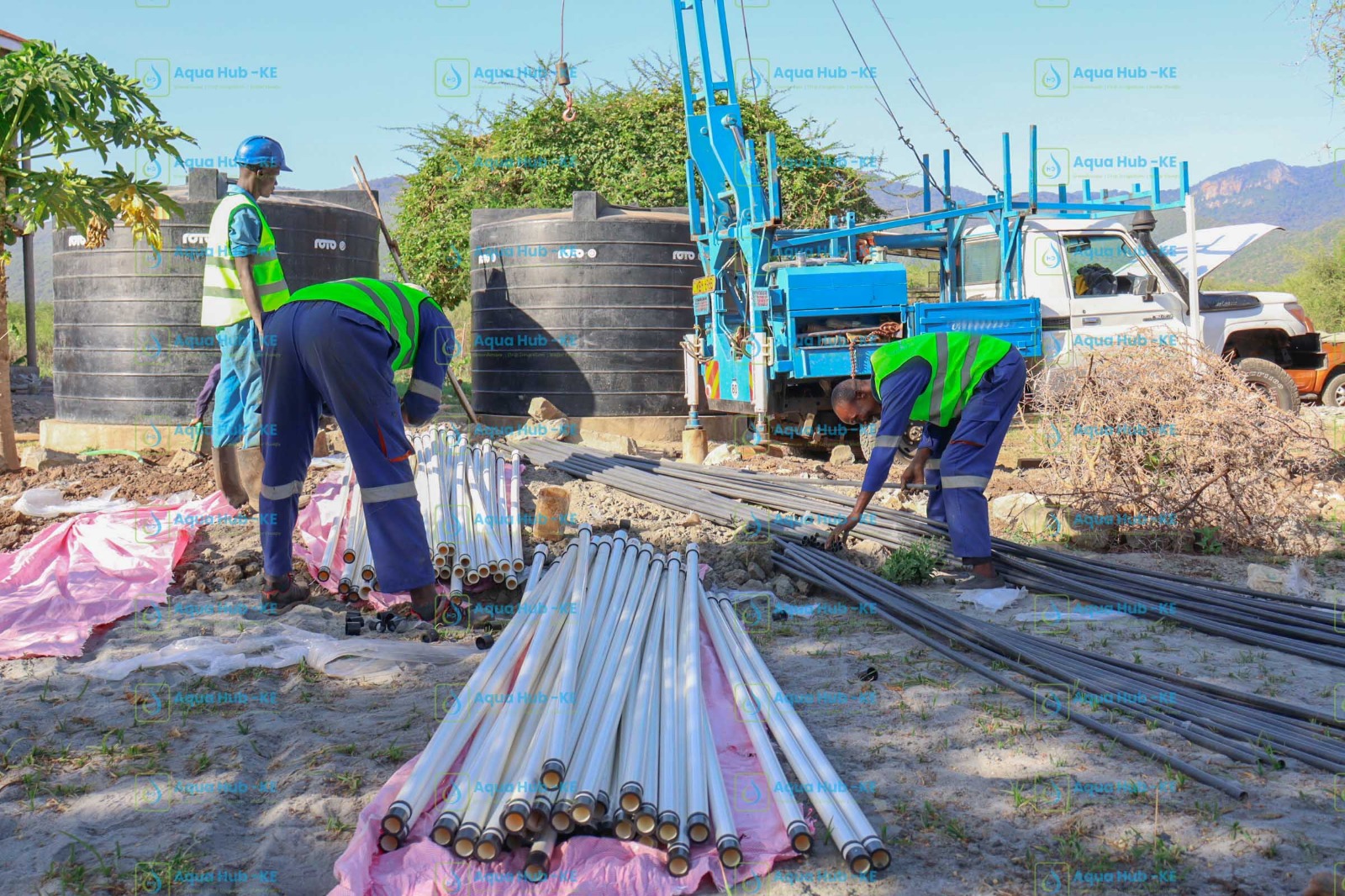
borehole equipping with solar pumps and accessories
What Is Borehole Drilling
Borehole drilling is the drilling of narrow holes beneath the ground to facilitate access to underground water.
When hydrological survey, drilling and equipping is done properly, you get a steady water supply even on dry seasons.
What makes boreholes convenient is that it the depth can be increased to boost yield in case the borehole yield drops.
Requirements for Borehole Drilling in Kenya
Before you get to drill a borehole, you must comply with the legal requirements. The requirements include:
Hydrogeological survey
- Gives a report on the underground water yield potential. Includes an estimate depth to drill, rock structure for determining borehole casing.
- Hydrological survey cost between KES 90,000 – KES 120,000.
Water Resource Authority (WRA) Permits
A permit issued by the water resource authority is required to drill a borehole. When applying for a water Resource Authority permit you need:
- Hydrological survey report from licensed hydrogeologist.
- Title Deed
- Plot Number
- Copy of National Identity Card
- KRA PIN Certificate
National Environmental Management Authority (NEMA) Permit
It is based on the assessment of how drilling of the borehole will affect the environment. If the assessment shows no negative impact will occur, then the permit is given.
How to Know Where to Drill a Borehole
Borehole hydrological survey determines the right location with high water table by using techniques such as resistivity.
Hydrological survey considers the rock structure, water table depth and nearby borehole yield to detect whether a place is viable for drilling.
How Borehole Drilling Is Done
- Hydrogeological Survey: Seeks to establish rock formation, depth, and location with high water table. Essential to obtain WRA and NEMA permits.
- Borehole Drilling: includes drilling the ground to the depth with water and casing the borehole to prevent contamination or wall collapse.
- Test Pumping: determine the yield of the borehole and helps size the correct pump for the borehole. It often takes 24 hours.
- Water Chemical Analysis: to determine the safety of water before drinking or other household needs. If water has salts treatment should be done.
- Borehole equipping: installation of UPVC delivery pipes, borehole pumps, and water towers or tanks.
Common Borehole Drilling Methods
Rotary drilling: faster and ideal for deep boreholes
Percussion: cheaper and slower.
After drilling, the borehole is cleaned and stabilized. This ensures better water flow and reduces sediment.
How Deep Should a Borehole Be? Be
The depth of your borehole depends on your location. For regions with a low water table, the depth will be high. In regions with a high water table, such as lake regions, the depth will be lower.
Borehole Casing and Development
Borehole casing protects the borehole wall from collapsing and prevents contamination of the borehole water. Common borehole casing includes PVC or steel casing.
Borehole Test Pumping
Borehole test pumping evaluates how much water your borehole can produce. Knowing the amount of water generated by the borehole helps you size the correct pump. It also determines the recharge rate of the borehole to ensure the pump to use will not overdraw water.
Borehole Camera Inspection
Borehole inspection is done using a borehole camera, which shows water levels, cracks on the casing, blockages or pump issues. It is done by expert borehole servicing technicians when water draw from the borehole fails.
Which Borehole Pump to Use
The right borehole pump depends on the depth, power access and your daily water requirements.
If you are living in areas with unreliable grid power, a solar borehole pump is ideal.
On the other hand, for low water needing household applications, an electric pump would be an option.
How to Test a Borehole Pump
Borehole test pumping monitors the power consumption, flow rate and pressure of water. If the output of a pump is below the expected rate, the pump certainly has failure issues.
Borehole Water Quality Analysis
Borehole water quality analysis ensures water is for drinking, irrigation and household needs. Tests detect salinity, bacteria, and chemicals to identify the appropriate treatment method.
Frequently Asked Questions
1. How much is drilling a borehole in Kenya?
KES 6,500 – KES 10,000 per meter.
2. How deep should a borehole be in Kenya?
Most are 70–250 meters deep, depending on geology.
3. How many litres of water can a borehole produce per day?
Boreholes can yield up to 8 cubic metres or more.
4. How long does it take to drill a borehole in Kenya?
4 – 10 days depending on the depth.
5. How much is a borehole permit in Kenya?
KES 90,000 – KES 200,000.
6. How far apart should boreholes be in Kenya?
200 – 300 m for optimal water yield.
7. Does rain increase borehole water?
Yes. Rainwater replenishes ground water table.
8. Does a borehole need maintenance?
Yes. Regular inspection of the casing, water level, and pump is essential to ensure optimal water yield.
9. How deep does a borehole need to be?
It depends on the location. Often goes between 60 and 250 m or more.
10. Can I drill a borehole myself?
No. It requires mobilising and equipping by expert drillers. Aqua Hub LTD conducts borehole drilling.